

The Georgetown Hoyas head into Christmas break with a record of 9-4, 1-1 in the Big East, and have sprinkled together a combination of promising and frustrating performances. The promising moments peaked with a 79-74 home win against now KenPom #35 Clemson to move to 4-0 in front of a lively Capital One Arena crowd. But since then, an injury to instrumental center Vince Iwuchukwu and a leave of absence from sixth man DeShawn Harris Smith has weakened depth and compounded frustrating results, marked by close losses to Dayton and Xavier, blowout losses to North Carolina and Miami (FL), and generally malaise underperformances in the team’s final four “buy games”. I figure now is as good a time as any to pause and reflect on where the Hoyas are, why they’re there, and what we can hope for in the final 18 Big East games.
THE CENTER ROTATION:
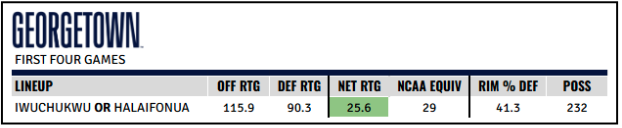
In the dog days of summer and in the lead-in to GLOBL Jam in Canada, Gideon and I made it pretty clear that the biggest question mark on this roster was likely the quality of the Center rotation. In the first four games of the season – with a healthy Vince Iwuchukwu and Julius Halaifonua – that seemed to not be the case. The two offered a yin and yang compliment to each other, with Halaifonua the finesse offensive hub and Iwuchukwu the rangy long defensive anchor. In the four games both were available, the Hoyas posted a +25.6 NetRtg (an adjusted metric to estimate net point advantage per 100 possessions against an average NCAA team), equivalent to 29th in the country, in the 232 possessions either one of Iwuchukwu or Halaifonua were on the floor. The pair had a collective DefRtg (an adjusted metric to estimate points per 100 possessions allowed) of 90.3, a miniscule number, that confirmed what we thought after George Washington and Kentucky scrimmages – that the Hoyas had a defensive first identity.
Following the Clemson win, it was announced that Iwuchukwu would be sidelined 6-8 weeks following a medical procedure, likely related to his cardiac arrest event sustained while at USC.
His departure marked a change in the Hoyas, who promptly lost their defensive efficiency and became painfully undermanned in the frontcourt. Since then, the Hoyas have gone 5-4 with a record of 1-4 in “non-buy games”, with the only win coming against KenPom #115 Marquette (who are 0-7 in “non-buy games”). Over that stretch, the team’s NetRtg has been +4.3, equivalent to 132rd in the country, and its DefRtg has been a lousy 109.1, equivalent to the 202nd best defense in the country. Interestingly enough, the rim defense has remained stout allowing only 51.6% FG at the rim (40th in NCAA) but the team’s ability to defend the midrange has crumbled, allowing a 51.8% mark in the region (361 of 365 Div 1 teams) – more on that to come.
Below, I’ve sorted and displayed the team’s efficiency amongst the four players who have shared time as the team’s Center over the course of the season.
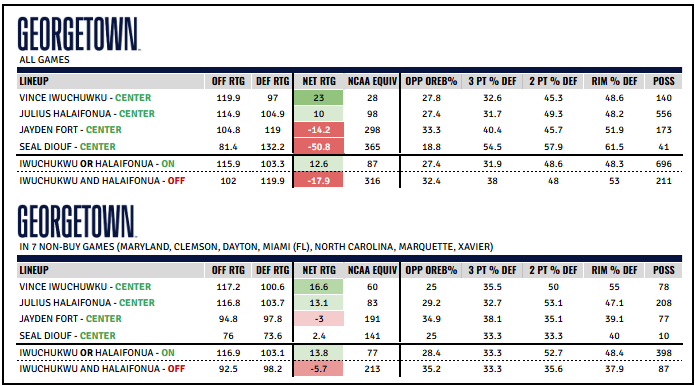
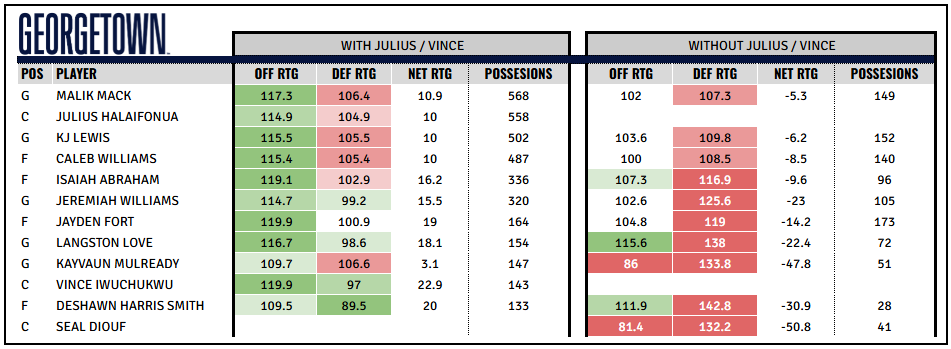
It’s quite clear the Hoyas couldn’t afford to need to turn to a third or fourth center this often (211 possessions). In those 211 possessions, they’ve sported a -17.9 NetRtg (equivalent to 316 in NCAA) compared to a respectable +12.6 rating when Vince or Julius is in the game. The discrepancy shrinks when isolated to the seven “non-Buy games” (a 19.5 Pts/100 difference) but it’s still so substantial that it has knee-capped both their floor and ceiling as a group. Every player on the team is markedly better with one of the two on the floor and only Kauvaun Mulready has a NetRtg less than +10 alongside one of them.
Now, the inconsistency of play amongst the centers is not a criticism of redshirt Freshman Julius Halaifonua, who has really blossomed over the 9 game stretch without Iwuchukwu. In fact, I think there’s a real argument to be made that he’s been the Hoyas’ best player.
Over the 9 games sans Iwuchukwu, Halaifonua has averaged:
- 16.6 ppg
- 6.3 rpg
- 1.2 apg
- 0.9 bpg
- 68% FG / 36% 3PT / 75% FT splits
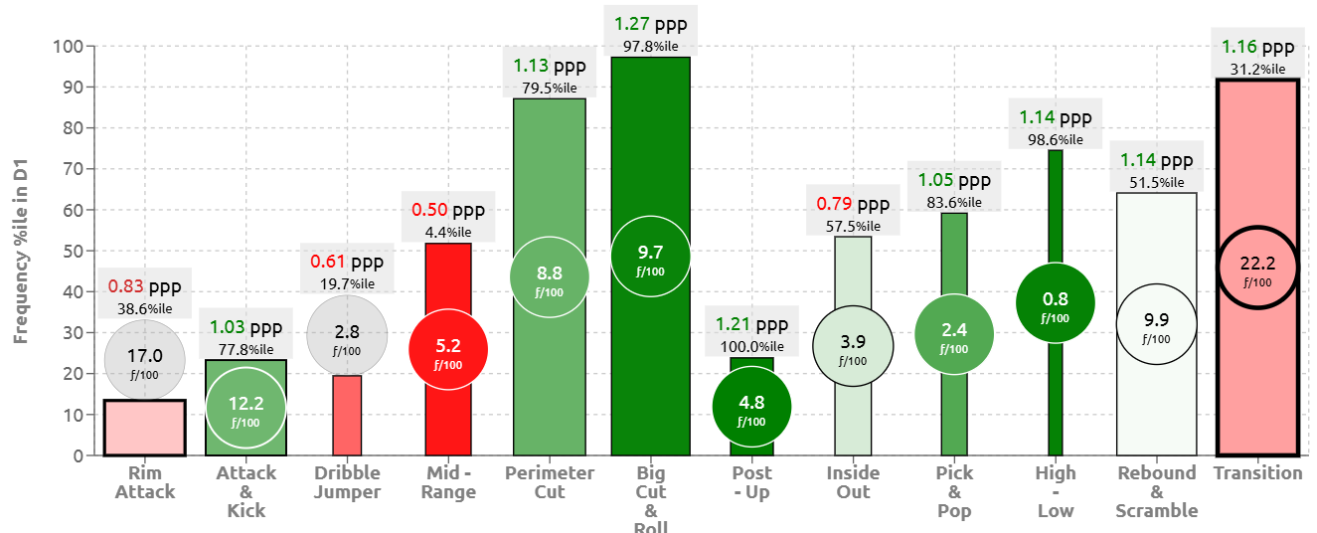
We’ve discussed it on the Finger WAG podcast, but he really has an incredibly diverse and polished offensive skillset. Before the scoring came around, it was evident he had great vision and was extremely comfortable passing out of the short roll. But over this 9 game span, I think he’s really understood that he can go get his own most times he chooses to. The Hoyas have been a bad shooting and transition team (both in the bottom third of NCAA) but they’ve been extremely efficient playing through Halaifonua. Since Iwuchukwu’s absence began and with Halaifonua in the game, the Hoyas are in the 98th percentile in scoring on “Big Cut & Roll” (1.27 PPP), the 100th percentile in scoring on “Post Ups” (1.21 PPP), and the 99th percentile in “High Low” (1.14 PPP).
Julius is the total package offensively. I hope they can keep him around for years to come and pair him again with Iwuchukwu sooner rather than later. He’s a future pro.
These numbers I’ve shared have been incredibly unkind to Jayden Fort, another redshirt freshman who has been thrust into a larger role than likely anyone expected. I think they’re also incredibly unfair to him as he’s been miscast as a depth “5” out of a necessity. Where Fort’s strengths lay are as a Power Forward, sharing the floor with a Center. In these moments, he doesn’t have the responsibilities that come with anchoring a defense and instead, he can do what he does best – be a ball magnet.
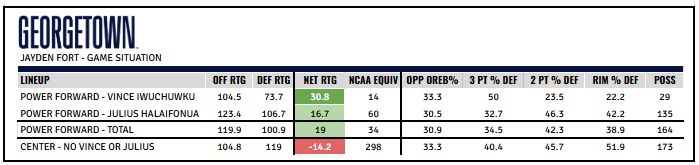
In the 164 possessions he’s gotten the chance to play the “4”, the team has an impressive +19 NetRtg, as opposed to an abysmal -14.2 NetRtg when he’s asked to play as a Center. In these chances as a Power Forward, the team’s been ELITE defending the rim (38.9% FG) and extremely active on the offensive glass (34.2% OReb rate).
I’m very bullish on what he looks like as he matures. He has a rare combination of athleticism and shotblocking instincts. In time, the game will slow and he’ll be able to assume more responsibility, but for now I think he’s admirably injected some physical fortitude into a group that has lacked it sans Iwuchukwu. It’s just unfortunate how undermanned the group feels when he has to play as the “5”.
THE DEPTH:
Heading into the season, I think most felt that the Hoyas were deeper than versions of the past with numerous guys that – at the very least – had the physical pre-requisites to belong at the Big East level. This has been really tested with the absences of Iwuchukwu and Harris Smith and everybody in the frontcourt has probably been asked to do a little too much. This group would look so much better if you had 40 minutes of Halaifonua/Iwuchukwu, if Fort was exclusively a depth Power Forward, and if Caleb Williams and Isaiah Abraham were auxiliary connective tissue rather than both being critical starters.
FRONTCOURT:
That being said, I think Caleb Williams and Isaiah Abraham have assumed much of that responsibility well and I think are great assets for the future. Caleb has made a significant jump despite being asked to likely do too much. He’s having to be this group’s third or fourth scorer depending on the night while guarding “fours” without a real defensive anchor behind him. Some matchups have certainly gotten the best of him (Malik Reneau, Caleb Wilson, Tre Carroll) but it’s a tough ask for him. The team has also played a lot of zone (to mixed results) but he’s assumed a ton of responsibility as a rebounder in space and he’s done well with it in my opinion. He’s additionally really battled with some early foul trouble (and likely deserves criticism for it) but personally, I find it hard to criticize a sophomore averaging 11 points and 6 rebounds on 49% FG / 36% 3PT / 82% FT splits. His True Shooting percentage lies at 60%, an extremely efficient number for a mostly perimeter player (Mack and Lewis hover around 51% for example), and he doesn’t turn it over (10 turnovers total, 8.2% TO rate). Personally, I’m really comfortable with him being a major part of our frontcourt moving forward.
Abraham, in my opinion, deserves some exaltation as well. He has the team’s best NetRtg (not including Iwuchuwku and Harris-Smith) at +10.6 and his True Shooting percentage has risen to 59.4% after a recent stretch in which he’s made 8 of his last 13 three point attempts. He doesn’t make a lot of mistakes, has the athleticism to survive at the Big East level, and seems to be making serious progress as a jumpshooter. Like Caleb, I think he’s good connective tissue at the High Major level in that he doesn’t really hurt you out there and he’s got serious potential as he progresses as a scorer and shooter.
BACKCOURT:
Where I’m actually very critical of the depth is in the backcourt, which hasn’t been stretched thin like the frontcourt. KJ Lewis and Malik Mack have each played north of 30 minutes per game but the trio of Langston Love, Jeremiah Williams, and Kayvaun Mulready have been asked to back them up and share the court plenty in three guard sets. I think all three have left a lot to be desired.
On Langston Love, I have mixed feelings. He’s fallen extremely short of what you were expecting: a player who in his career had played on three tournament teams, averaged 9 points per game, shot 39% from three, and just last March scored 15 and 11 in two NCAA tournament games against High-Major opponents. An injection of a player of that quality right now would do wonders to solve the depth issue. But it’s been very clear that Love is not himself physically as he’s battled with lower body injuries and sickness all season. His On/Off numbers at surface value don’t look great (+4.6 NetRtg) but at a closer glance, the team has actually been decent with him out there. A 10 possession runout against Binghamton in which Georgetown was outscored 21-7 really tanked his numbers. Outside of that 10 possession stretch he actually has a +11.6 NetRtg (which would top Abraham’s). He has the team’s highest NetRtg (+19.6) in the seven “non-buy games”. He has a +18.1 NetRtg when playing alongside Vince or Julius (as opposed to a –22.4 NetRtg with a third or fourth center) and he has a +22.8 NetRtg in his 142 possessions solely along Halaifonua. Now I don’t think he’s going to capture any sort of the scoring punch or athleticism that made him a solid player for tournament teams at Baylor but in my opinion, they have to continue to let him play his way into confidence and into shape. At the very least, he can be a potential shooter that makes the right play on the offensive side of the ball. And concerningly, I think he’s their most viable option as a depth piece.
On Jeremiah Williams, I’ve been pretty disappointed. He came on board as a veteran leader type with a plethora of experience (74 career starts across Temple and Rutgers). What they needed from him was going to be responsible play on the offensive side of the ball and a pitbull mentality on the defensive side of the ball. Over the course of GLOBL Jam and the two exhibitions he displayed that. Over that stretch (exhibitions I know) he shot 18-35 from the field (51.4%), 14-23 from 2-pt range (60.8%), and 4-12 from 3 (33.3%). In the two exhibitions vs George Washington and Kentucky, he was great defensively at the point of attack. In his 42 minutes he was a +17 and the Hoyas allowed (a self charted) 0.89 points per possession in his 77 possessions. Conversely, in the regular season, he’s been extremely inefficient attempting to score the basketball and his defensive numbers have not been too impactful. I’m listing his shooting numbers below but he’s posted career worsts in FG%, 2 point FG% and True Shooting % (by a significant margin) as well as in FT%. No more was his inefficiency on display than in the close Xavier loss in which he ended 10 possessions via shot, turnover, and drawn foul … to the tune of 3 total points.
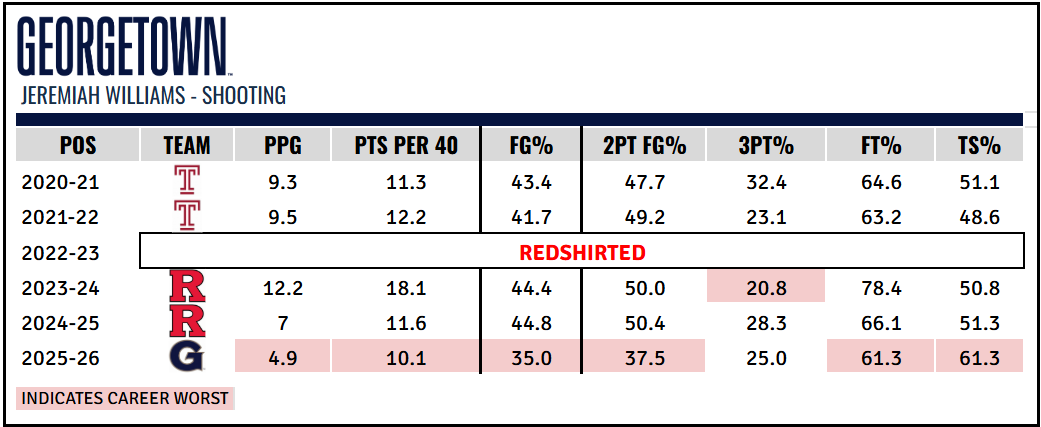
Defensively, his numbers haven’t been awful – they’ve been fine. The Hoyas allow 1.04 PPP when he’s on the floor, which is slightly better than the 1.07 PPP they allow with him off the floor. The saving grace here is that the Hoyas have allowed only 0.98 PPP defensively when he’s shared the court with Julius or Vince so maybe that defensive game-changer on the perimeter can find something again.
On Kayvaun Mulready, there’s growing evidence that it’s going to be really hard to play him in any sort of important situation. Over the course of the season, he now has a -10.1 NetRtg, more than 12 points worse than any other player in the rotation. In seven “non-buy games” against real competition, he’s played 45 minutes. In those 45 minutes, Georgetown has been outscored by 33 points and Mulready has scored 3 points on 1-10 shooting (1-6 from 3). I think what is most concerning with Mulready is his shot selection and his inefficiency in taking those shots. His pathway onto the court was via shooting, evident by his 5-12 three point display over the two exhibitions, but he’s been extremely inefficient in the regular season. Not only is he shooting a measly 14.8% from beyond the arc, but he’s taking 9.1 three-point attempts per 40 minutes. His 3PA rate is seventh amongst all Big East players behind Austin Swartz, Isaac Traudt, Stefen Vaaks, Bryce Lindsey, Jason Edwards, and Solomon Ball (all stud shooters). Quite frankly, those are lost possessions and if Mulready was to find usefulness, it needed to be as a defensive first guy that doesn’t hurt you out there.
Either way, all three have hurt far more than they’ve helped and a Georgetown team that was always going to have a hard time shooting has been especially plagued by their bench. The team’s five typical starters are actually shooting 34.0% from three (71 of 209) while the team’s bench has shot 19.1% from three, contributing a total of just 13 three point makes on the season.
BACKCOURT:
The good news is that the Hoyas do have a real starting backcourt between Malik Mack and KJ Lewis, who have been mostly good albeit probably not one of the best backcourts in the country as Ed Cooley has alluded to. On the Finger WAG, I alluded to Mack’s need for progression in essentially all aspects of the game – shooting efficiency, facilitating, and just general physicality. I also noted that in recent Big East history, most Point Guards that made the jump from Mid-Major hoops made their most significant jump in their second year at the level.
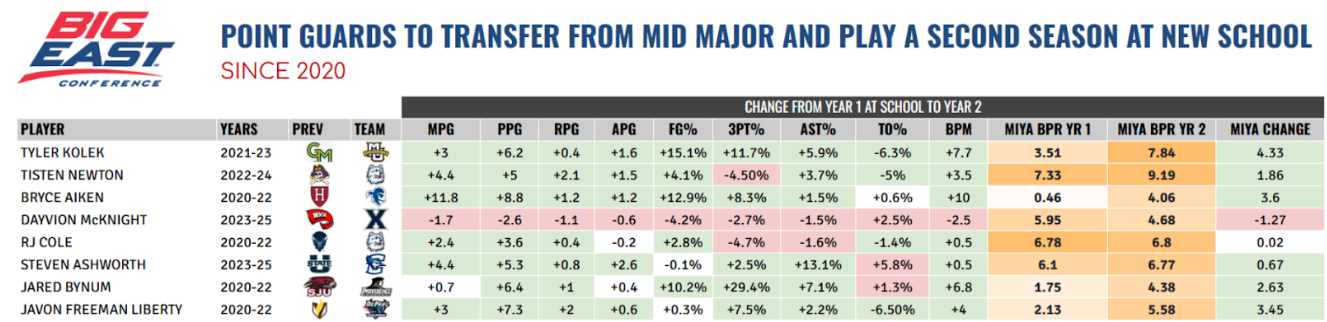
Notably, Tyler Kolek and Tristen Newton made enormous jumps which led to a BE POY award for Kolek and a second National Championship for Newton.
Now, Malik has made SOME jumps in the areas you’d like him to but I think they need to be a little larger for this team to be the group they want to be.+
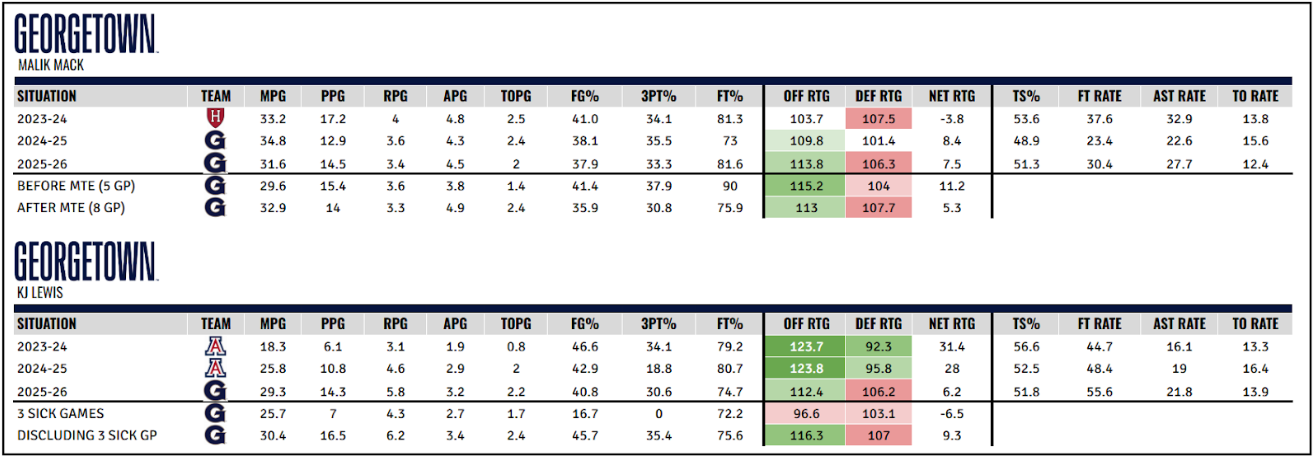
If you refer to the above graphic, Mack has made jumps from last year in his scoring, True Shooting percentage, Free Throw rate, and Assist rate but all four numbers are still shy of his eye-popping numbers produced at Harvard in his Freshman year. His ability to not turn the ball over has shown great progression as well, and has been a huge reason Georgetown has been a top 5 team in the country in Offensive Turnover Rate. In all this, there is no doubt he’s been better than last year.
That being said, I do have two minor gripes with Mack’s first 13 games. First, Mack’s offensive efficiency has taken a significant downturn since Thanksgiving (sans Iwuchukwu) – a stretch where the Hoyas really needed him. In the first two weeks (especially against Maryland and Clemson), Mack looked to be a new player. He was obviously bigger, more in control, and in both big games made critical shots in the Second Half. But since the MTE, he’s shooting only 36% from the field and less than 31% from three point range. It’s hard not to see that he’s still a volatile player who plays very well when things are going well but sometimes has a hard time correcting things within a game when things aren’t going his way (such as in the UNC game when he scored 9 points on 3/17 FG). Second, he has not been commanding and dominant enough in “buy games” for me. He’s been quite good in the seven games against real competition, posting a +15.3 NetRtg, and sporting a 30.4% Assist rate juxtaposed to a 14.1% turnover rate against Tier A/B teams per KenPom. But in the six “buy games”, he’s posted a -3.3 NetRtg and in the Hoyas two most recent contests against St. Peter’s and Coppin St, Mack scored 14 points on 3/14 shooting while turning the ball over 7 times. Quite frankly, a player of his caliber should have total control of these games and as your point guard, should set the expectation of focus and intensity.
KJ Lewis has been better in my mind, but not without his own volatility. What’s likely unfair to Lewis is that he’s forever married to Micah Peavy due to their overlap with Micah’s father and Duncanville. It’s been well documented that he’s not at 3700 O St. without Micah’s success and David Peavy’s suggestion. The jump that Peavy made is so rare (and so much of it was done in the second half of the season), that it’s difficult to ask for the same excellence of Lewis.
That being said, Lewis has been a very good player. He was clearly sick from the St Peter’s game through the Xavier game and it showed (7 ppg, 16.7% FG, 0 made threes, -6.5 NetRtg).
In the 10 games outside of that, his stats are the following:
- 16.5 ppg
- 6.2 rpg
- 3.4 apg
- 2.6 spg
- 46% FG / 35% 3PT / 76% FT
- +9.3 NetRtg
He’s made some mistakes defensively. Specific gambles in late game moments against Dayton and Xavier likely deserve criticism but I find it hard to really criticize a player that’s contributing in all the facets listed above, while playing harder than just about every other guy on the roster. It’s also difficult to ask one player to be a one-man wrecking crew defensively. Micah Peavy was as good of a positional and team defender as we’ve ever had and he had a 110.6 DefRtg when playing without Thomas Sorber last year.
If I actually did have one major criticism of KJ Lewis, it’s of how he’s played in transition. In theory, he should be one of the country’s best transition players. A bat shot out of hell, he can be a one-man fast break, and his downhill ability contributes to him being fouled at an absurd rate (55.6% FT rate – in the 99th percentile nationally). Despite all of this in his favor, he’s only scoring 1.11 points per possession in his transition opportunities (15th percentile in NCAA). His transition inefficiency has been a staple of this Georgetown team, who – across the board – score only 1.10 PPP in transition (14th percentile) and shoot 51.6% from two point range in transition moments (325th in NCAA).
BUY GAME WOES:
Yes, Georgetown went 6-0 in “buy games”. Yes, Georgetown doesn’t have a Quad 4 loss to their name. But in the era of metrics (KenPom and NET) where margin of victory in these games matters, the Hoyas receive a failing grade. Across the six “buy games”, they went 0-6 against the spread and missed the number by a combined 54.5 points. As a team, they played to an exactly even 0 NetRtg, equivalent to what would be the 175th best team in NCAA. In these games, they had a DefRtg north of 112 (a very poor mark), and played remarkably worse in the second half (-11.8 NetRtg and 123.6 DefRtg). Below, I’ve listed every player’s discrepancy in NetRtgs between the 6 “buy games” and the 7 “non-buy games”. It’s … stark.
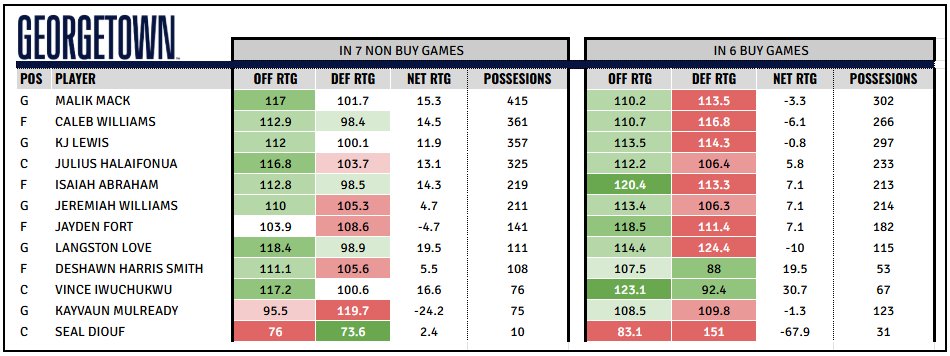
In the six wins, they’ve won by a combined margin of 50 points less than their largest leads which points to their inability to stay focused and interested for the entirety of these contests. It sounds meaningless, but you have to pile on. If this team was 50 points better over the course of their 904 possessions played this season, that is a roughly +5.5 increase in your NetRtg. They’d likely be ranked in the 60-70 range in KenPom (or NET that is) rather than at 103 and 140 respectively had they just handled business for the entirety of these contests.
STATE OF THE HOYAS:
What matters much more than the margin of “buy games” though are results in close contests. This team always had razor-thin margins if they had hopes for the NCAA Tournament and the losses to Dayton and at home vs Xavier (a Quad 3 loss) make the path forward an extremely steep one. The unfortunate thing is – had they not lost Vince Iwuchuwku and had they gotten a fully functional DeShawn Harris Smith from Clemson until now – they’d very likely be 11-2. Along this stretch without Vince, they were always going to have 5 “non-buy games”. 3-2: would’ve been gravy. 2-3: the minimum to stay afloat. 1-4 or worse (which they happened to go): likely a death sentence. It wreaks of bad Hoya luck, who have now lost their best center for 19 games spanning the past two seasons. For what it’s worth, over Ed Cooley’s last 9 seasons at Providence in which he made 7* NCAA Tournaments (including the lost COVID tourney) and had eight top 75 defenses nationally, his starting centers missed a combined 5 games.
I do think Cooley deserves some criticism for not fielding a functional defense though, regardless of injuries. The team’s defense at the rim has actually held up quite well but they’ve been crushed on the perimeter, specifically in the mid-range.
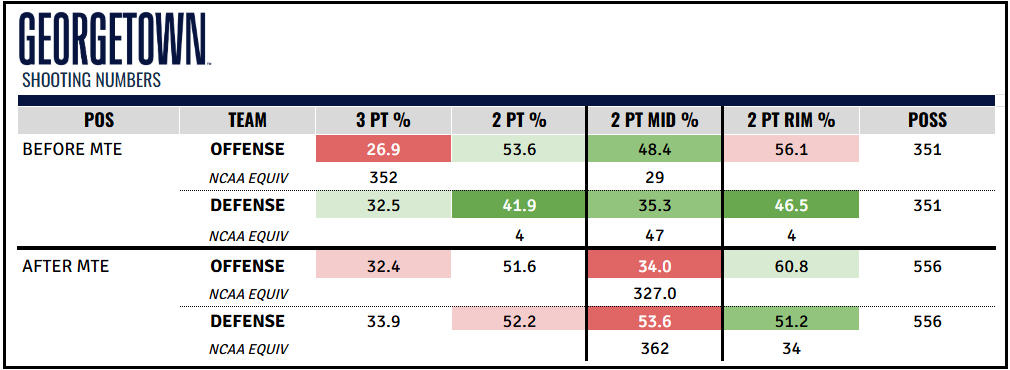
While they held opponents to shoot 35.3% from mid-range over the first 5 games, they’ve allowed opponents to shoot 53.6% from mid-range in the next eight games (good for fourth worst in the country). It’s easy to look at how stifling the shot defense was for good stretches of the first 5 games and point to Iwuchukwu, but a mid-range defense that poor points to a lack of connectivity and physicality from the perimeter guys. UNC and Miami (FL) shot a combined 24 for 31 from mid-range, a stat so absurd it’s almost hard to believe. It also hasn’t helped things that offensively, we’ve been one of the country’s worst mid-range shooting teams over those same eight games. Not every mid-range shot is created equally.
I also think it’s concerning that Cooley put together a decade of quality defenses at Providence but now at Georgetown, his only defensive solution over two and a half years has been Thomas Sorber. Take a look at this:
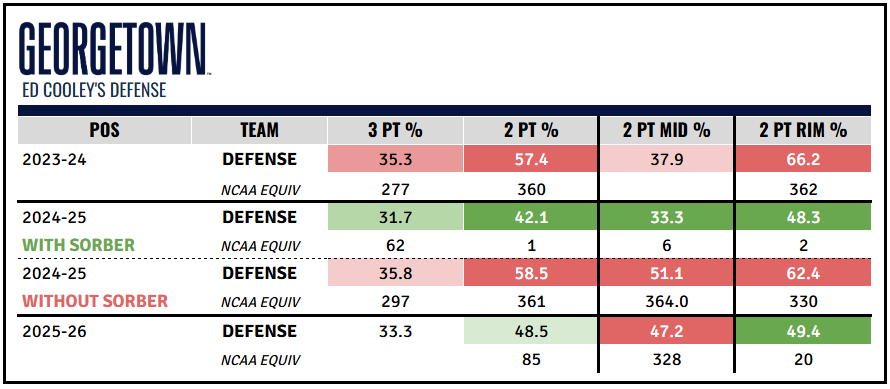
Each defense has had their own Achilles Heel. Year One’s was that they were short on athletes and lacked any rim protection, resulting in pretty horrific defense across the board. The two-point defense and especially rim defense were as bad as you’ll ever see. Year Two’s defense was undone by the Sorber injury. It’s almost impossible to look at those numbers above from 2024-25 juxtaposed on top of each other and believe they are real. Sorber may be one of the more impactful defensive players in history. Now Year Three’s Achilles Heel has been the midrange, which I won’t continue to go on and on about. Either way, it’s time to put together a defense that defends at three levels, which was non-negotiable for this team to have success.
Additionally (and I just have to make note of), when Ed Cooley’s team are playing like they’ve been – with a lack of physicality, execution, and significant results – he absolutely cannot afford the antics like those that followed the Xavier game. We’re all frustrated but I get the sense that Cooley’s especially frustrated he hasn’t been able to impact the things he thought he’d have momentum with by now. At a place like Providence – with a sports crazed local community, a nearby alumni base, and a reasonably sized arena – it was feasible to quickly drum up fan support and create one of the sport’s best home court advantages. At Georgetown, the students are mostly apathetic towards sports, the young alumni base is mostly in New York City, and the downtown arena is just too large to create a real atmosphere. Add the fact that support has waned over a failing decade, and it’s unlikely the chicken comes before the egg. The Hoyas have to win (and win big) to get people back in seats.
MOVING FORWARD:
The Hoyas have 18 Big East games remaining. 12 wins are likely required to even have a chance at the NCAA Tournament (which Bart Torvik gives Georgetown a 0.3% chance of making). A 9-9 record the rest of the way likely doesn’t drum up a ton of excitement but in my opinion, is required to feel like this program is taking steps in the right direction. Now how do they get there? The hope must be that an eventual Iwuchukwu return is a magic pill. Perhaps the second semester addition of Gabriel Landeira, who gave Georgetown fits at GLOBL Jam, shores up backcourt depth. As I’ve hammered home, margins are thin but the program is on the precipice of becoming healthy again. There are players on this roster worth retaining and building around and an inspired end to this season should allow you to put together expensive and cohesive groups in the years that follow.
In reality, 9-4 (1-1) is probably where I would have expected us to be in August. The unfortunate truth however is that the competition has been worse than expected (Marquette and Maryland especially) and that they squandered two games that they really should’ve and needed to win in Dayton and Xavier.
And as such, we constantly fight further apathy. It’s getting close to now or never.
Special Thank You to KenPom, Sports Reference, and hoop-explorer for providing all of the data.

Nice analysis Jake and thank you!
No surprises here after watching every game but your metrics support what I am seeing.
Mid-January and on could be interesting (and hopefully very productive) with Gabriel and Vince on board.